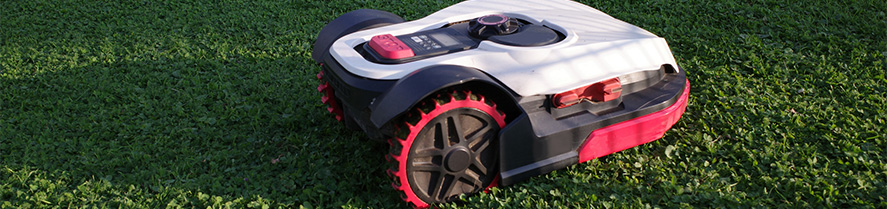
Building a robotic lawn mower is significantly more challenging than many indoor robotics applications. Outdoor environments are unpredictable, lighting conditions constantly change, and mowers must reliably detect obstacles such as pets, toys, hoses, trees, and uneven terrain in real time.
Traditional approaches based on perimeter wires and simple proximity sensors can handle basic navigation, but they become increasingly limiting as robotic mowers move toward wire-free autonomy, higher operating speeds, and more complex environments.
As a result, many newer robotic mower platforms are beginning to incorporate LiDAR as part of their perception stack. LiDAR provides direct distance measurements that can improve outdoor localization, obstacle detection, and navigation reliability across varying lighting conditions.
For developers evaluating robotic mower architectures, selecting a LiDAR sensor involves more than comparing range specifications. Detection range, field of view, resolution, environmental robustness, compute requirements, and system integration complexity all affect real-world deployment performance.
The Challenge of Outdoor Robotic Use
Autonomous outdoor use is trickier than indoor robotic applications. The following factors complicate robotic lawn mower navigation and establish the performance requirements for LiDAR systems.
- Unstructured environments lack predictable geometry and often contain vegetation, irrigation systems, uneven terrain, furniture, toys, and landscape borders. Robotic mower sensors must reliably detect large and low-profile obstacles while maintaining stable navigation across changing outdoor conditions.
- Environmental exposure creates additional reliability and maintenance considerations. Robotic mower platforms must operate through dust, moisture, grass clippings, and temperature variation while maintaining stable perception performance. Sensor packaging, enclosure integration, and environmental protection ratings all affect long-term outdoor reliability and maintenance requirements.
- Variable lighting complicates camera-based navigation. Outdoor scenes often contain both extremely bright and dark regions within the same field of view, reducing perception consistency for vision-based systems. LiDAR provides direct geometric ranging that is generally less sensitive to ambient lighting variation.
- Dynamic obstacles demand real-time detection. Pets, children, and unexpected objects may enter the operating area without warning. The system must reliably detect moving obstacles and trigger emergency stops within milliseconds.
- Terrain variations increase navigation complexity. A robotic mower sensor must distinguish traversable ground from obstacles, including garden hoses, landscape borders, and drop-offs near ledges.
Critical Specifications for LiDAR Lawn Mowers
Selecting appropriate LiDAR hardware requires understanding how specific performance parameters affect autonomous mower capabilities. The following specifications impact navigation reliability, obstacle detection, environmental robustness, operational efficiency, and system performance.
Detection Range
Close-range detection, such as objects as near as 0.1 meters from the chassis, establishes critical safety margins. Extended detection range supports predictive path planning and efficient coverage patterns at higher operating speeds. Commercial platforms can further benefit from longer-range perception through reduced course corrections and smoother navigation behavior.
Field of View
Horizontal FoV can reach up to 270 degrees for forward and lateral environmental awareness in basic collision avoidance systems, while some premium platforms implement 360-degree coverage to reduce blind spots in more complex landscapes. Vertical FoV also affects the ability to detect obstacle height, terrain slope, and concealed features near the ground.
Resolution and Point Density
High angular resolution generates dense point clouds that improve detection of small obstacles, including garden stakes, sprinkler heads, and other low-profile objects. However, increased point density, which can reach 0.07 degrees by 0.027 degrees, also raises processing bandwidth, memory usage, and compute requirements. Consumer systems often balance moderate resolution with computational efficiency, while commercial platforms may prioritize higher perception accuracy and larger safety margins.
Adaptive Scanning
Fixed-pattern LiDAR allocates equal resolution across the field of view, which is inefficient when zones require different densities. Autonomous mowers benefit from high forward resolution, where obstacle detection determines speed, while lateral zones require only moderate resolution.
Adaptive scanning concentrates point density where requirements are highest, dynamically adjusting based on operational mode and terrain. This feature reduces processing overhead, lowers power consumption, and supports cost optimization. Advanced LiDAR systems adapt resolution distribution in real time, providing commercial-grade performance within the size, weight, and power constraints of battery-operated platforms.
Scanning Frequency
Higher scanning frequency improves the ability to detect environmental changes and moving obstacles in real time. Faster update rates can support smoother navigation behavior and safer operation at higher travel speeds, particularly in more dynamic outdoor environments.
Environmental Robustness
Outdoor robotic systems operate under continuous exposure to dust, moisture, rain, temperature variations, grass clippings, and airborne debris. Long-term reliability depends on sensor performance, enclosure integration, optical surface protection, and environmental sealing.
The International Electrochemical Commission has developed two ingress protection ratings, IP65 and IP67, to evaluate resistance to dust and water exposure in outdoor environments. Environmental robustness directly affects maintenance frequency, long-term stability, and deployment reliability in robotic mower platforms.
Size, Weight, and Power
Battery-powered mowers impose strict constraints on sensor size, weight, and power consumption. Compact, lightweight, power-efficient designs help extend operating time and coverage per charge.
Commercial platforms can often accommodate higher-performance sensor systems, while consumer products typically operate under tighter size, power, and cost constraints.
Navigation and Mapping Capabilities
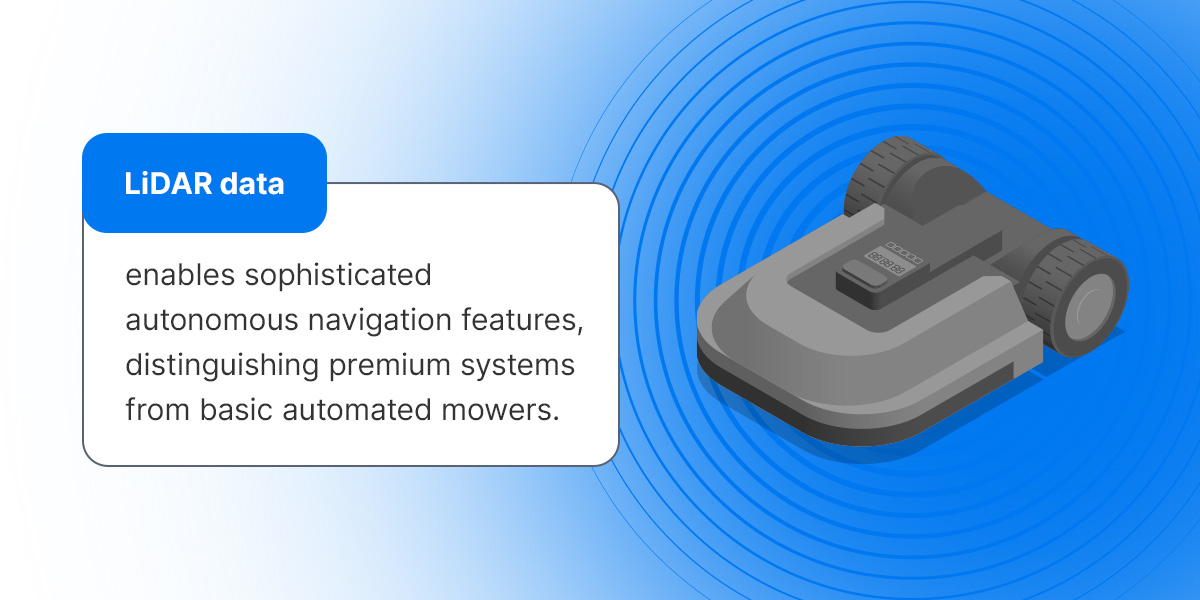
LiDAR data enables sophisticated autonomous navigation features in automated mowers, helping systems deliver more intelligent mapping, localization, and path planning capabilities in complex outdoor environments. LiDAR serves two essential functions in robotic lawn mower applications.
- Environmental mapping: LiDAR point cloud data can construct environmental maps, identify boundaries and obstacles, optimize coverage paths, and support return-to-base navigation with reduced overlap between mowing passes.
- SLAM and localization: SLAM algorithms process LiDAR scans to identify static environmental features such as trees, fences, and structures while continuously estimating vehicle position and orientation for stable autonomous navigation across changing outdoor environments.
Safety and Collision Avoidance
Safety represents the paramount concern for an autonomous LiDAR mower operating in environments shared with people and pets. LiDAR-based systems deliver multiple layers of protective functionality addressing regulatory requirements.
Object detection and obstacle avoidance algorithms identify unexpected obstacles and trigger avoidance or emergency stop behaviors when necessary. Real-time response is especially vital in environments shared with people, pets, and moving objects.
Pet and child detection uses object size, movement patterns, and proximity monitoring to identify high-priority obstacles. Safety modules in robotic mower systems apply strict detection thresholds that prioritize false positives over missed detections.
Slope and edge detection prevent operation near steep terrain, retaining walls, and drop-offs. Multiplane sensing can improve terrain awareness in uneven outdoor environments.
LiDAR-based systems support the following:
- Regulatory standards: IEC 60335-2-107 establishes safety requirements for robotic lawn mowers, including obstacle detection performance and emergency stop functionality. The U.S. adopted this as ANSI/OPEI 60335-2-107. Compliance requires documented testing demonstrating obstacle detection within specified distances and emergency stop execution within defined response times.
- Safety redundancy: Robust architectures combine LiDAR with mechanical bumpers providing last-resort collision detection, inertial measurement units detecting unexpected motion, and wheel encoders monitoring drive anomalies. This layered approach ensures no single sensor failure compromises safe operation.
System Integration and Maintenance
Integrating LiDAR into a robotic mower requires more than mounting a sensor on the chassis. The system must account for sensor placement, field-of-view coverage, power budget, and synchronization with other sensors such as IMUs, wheel encoders, and GPS modules. When properly integrated, a LiDAR-based lawn mower provides reliable geometric data that can improve localization, obstacle detection, and navigation consistency across outdoor environments.
Long-term operation introduces additional maintenance requirements. Dirt, moisture, grass clippings, vibration, and temperature fluctuations can affect outdoor mowers’ sensor performance over time. Robust enclosure design, protected optical surfaces, software update capability, and calibration management maintain perception reliability throughout the product life cycle.
Cost-Benefit Analysis
LiDAR systems typically introduce higher hardware and integration costs than simpler sensing solutions, but they can also improve navigation reliability, obstacle detection capability, and wire-free operation in complex outdoor environments. Many robotic mower platforms justify the trade-off with improved autonomous performance and reduced operational limitations.
Consumer robotic mowers often balance perception capability against cost, power consumption, and system complexity. Commercial platforms emphasize operational efficiency, coverage consistency, and reduced supervision across larger properties and longer operating cycles.
Long-term value also depends on system reliability, maintenance requirements, and product lifespan. Robust sensing and stable outdoor perception can reduce unexpected interruptions and improve long-term deployment consistency.
Cost Targets for Consumers vs. Commercial Markets
Consumer products targeting homeowners emphasize purchase price competitiveness. Commercial markets evaluate the total cost of ownership, including maintenance, labor savings, and efficiency gains, justifying premium systems through reduced supervision and expanded coverage.
Build Autonomous Robotic Mower Systems With Orbbec LiDAR-Based Solutions
LiDAR is becoming an important technology for efficient autonomous mowing as robotic mower platforms continue advancing toward higher levels of environmental awareness and autonomous operation. Selecting the right solution requires balancing sensing performance, environmental robustness, integration complexity, and long-term maintainability.
Orbbec provides complete LiDAR solutions and engineering support for robotics and embedded vision applications, helping developers accelerate system integration and product deployment. As Orbbec expands its robotics portfolio, we continue evolving beyond stand-alone sensors toward robust collaboration through JDM partnerships and full-stack perception solutions.
Explore our complete LiDAR solutions, order your ideal option, and test its features.
Frequently Asked Questions About Robotic Mower Systems
What LiDAR specifications matter most for robotic lawn mowers?
Detection range, field of view, and scanning frequency are the specs that most directly affect navigation and safety performance. Close-range detection down to about 0.1 meters establishes safety margins near the chassis, while a wide horizontal field of view (up to 360 degrees on premium platforms) reduces blind spots. Higher scanning frequency improves moving obstacle detection and supports faster travel speeds.
What IP rating does a LiDAR sensor need for outdoor mower use?
IP65 or IP67 ratings are the standard benchmarks for outdoor robotic applications. Both protect against dust ingress and water exposure, though IP67 adds submersion resistance. Long-term outdoor deployment exposes sensors to rain, grass clippings, temperature swings, and airborne debris, so enclosure design and optical surface protection matter as much as the ingress protection rating itself.
Can LiDAR detect pets and children in a mowing zone?
Yes. LiDAR-based safety systems use object size, movement patterns, and proximity thresholds to flag high-priority obstacles like pets and children. These modules are typically configured to prioritize false positives over missed detections, meaning the mower stops when in doubt. Robust architectures layer LiDAR detection with mechanical bumpers and IMUs so no single sensor failure compromises safe operation.
What safety standards apply to LiDAR-equipped robotic mowers?
IEC 60335-2-107 is the primary international standard for robotic lawn mower safety, covering obstacle detection performance and emergency stop requirements. The U.S. version is ANSI/OPEI 60335-2-107. Compliance requires documented testing showing obstacle detection within specified distances and emergency stops executing within defined response times.
What is adaptive scanning and why does it matter for robotic mowers?
Adaptive scanning dynamically adjusts point density across the field of view based on where detection requirements are highest. On a robotic mower, that typically means concentrating resolution forward where obstacle detection determines speed, while reducing it laterally where only basic awareness is needed. Fixed-pattern LiDAR allocates equal resolution everywhere, which wastes processing bandwidth and power on zones that don’t need it. Adaptive scanning reduces compute load and power consumption without sacrificing detection where it counts.