Selecting a depth camera for an AMR fleet is not simply a component decision. It is a deployment architecture decision that influences integration complexity, host compute requirements, and long-term deployment and maintenance costs across the operational life of the platform.
This guide explains the technical factors that influence depth camera selection in warehouse automation applications. It compares the major depth-sensing technologies for different warehouse applications and discusses the engineering considerations that matter beyond the datasheet.
Decision framework: choosing the right depth camera for your warehouse application
Depth camera selection depends on the specific function the robot performs. A camera that works well for long-aisle navigation is not necessarily suited for bin picking, and vice versa. The table below maps four common warehouse automation scenarios to the technical requirements that drive product selection.
| Use case | Required range | Critical spec | Recommended technology |
| Long-aisle pallet transport | 10m+ | Depth accuracy at range; IP rating | Active-passive stereo; wide baseline |
| Tight-corner AMR navigation | 0.1m to 5m | Wide FoV; short minimum range | Stereo or ToF (application-dependent) |
| Bin picking / robotic arm | 0.1m to 1m | Sub-mm spatial precision | Active stereo or structured light |
| Outdoor dock / variable lighting | 5m to 20m+ | IP65+; sunlight robustness | Active-passive stereo; sealed housing |
Rather than starting with a specific camera technology, define the application’s working distance, operating environment, and accuracy requirements first. These factors determine which depth-sensing technology and camera characteristics are most appropriate.
Technical requirements by application
Manufacturer datasheets report specifications at controlled reference distances and lighting conditions. What those numbers mean for your specific deployment scenario depends on the operating range, environment, and system constraints of each application.
Long-range navigation: pallet transport and inter-zone travel
For robots traveling long aisles or between warehouse zones, working range and depth accuracy at distance are the governing specs. Stereo cameras experience depth error that grows with working distance; accuracy degrades beyond the near-field reference conditions reported on the datasheet. A wider stereo baseline compensates by improving triangulation geometry at longer range.
The Orbbec Gemini 335L uses a 95mm stereo baseline and specifies spatial precision of 0.8% at 2m and 1.6% at 4m, with a working range of 0.17m to 20m+ (optimal range 0.25m to 6m). The 335L also includes hardware trigger support, which enables synchronized operation across multiple cameras in deployments where IR emitter interference between robots in shared aisles is a concern.
Precision manipulation: bin picking and assembly
Bin picking success rates depend on the accuracy of the 3D point cloud at the arm’s working distance, typically 200mm to 500mm. At those distances the relevant specification is not range but spatial precision and minimum point distance (the smallest distinguishable spacing between neighboring points), which determines how finely the system can resolve adjacent objects within a bin.
The Orbbec Gemini 215 is an active stereo camera designed for close-range, high-precision applications. It is optimized for close-range precision work with specified depth range from 0.15m to 0.70m spatial precision below 0.5mm at 0.3m and minimum point distance of 0.16mm at 0.15m. The camera is rated for indoor use only (0°C to 40°C), which is a relevant constraint for warehouse deployments with outdoor dock exposure or variable lighting. It is a short-range precision camera, not a navigation sensor. Applications requiring both long-range navigation and close-range manipulation typically require two separate sensors optimized for each function.
For many industrial manipulation tasks that require fine geometric detail at close range, active stereo is often preferred because it can provide higher spatial precision within the working distance. Depending on the application, modern ToF cameras may also be suitable, particularly where robustness and ease of integration are prioritized.
Depth technology comparison: stereo vs ToF vs LiDAR
The three main depth-sensing technologies each have performance profiles suited to different warehouse scenarios. The comparison below covers the trade-offs relevant to AMR navigation and manipulation applications.
| Stereo vision | ToF | LiDAR | |
| Typical range | 0.1m to 20m+ | 0.1m to 6m | Up to 100m+ (product-dependent) |
| Sunlight performance | Good with active illumination | Degraded by IR saturation | Good (pulsed laser) |
| Host compute load (with in-camera processing) | Reduced with in-camera ASIC processing | Low (on-chip) | High (dense point cloud) |
| Primary warehouse fit | Navigation and manipulation across range | Short-range, controlled indoor lighting | Large outdoor yards; high-speed vehicles |
Stereo cameras using active illumination (structured IR patterns projected alongside passive stereo) maintain stable performance in variable lighting conditions, including areas with skylights or outdoor dock exposure, where purely passive stereo and ToF cameras can be more susceptible . This is the basis for the active-passive stereo designation on cameras like the Gemini 335 and 335L series.
LiDAR delivers the longest unambiguous range and is well suited to large outdoor yards and high-speed autonomous vehicle applications. For most indoor AMR deployments operating within typical warehouse dimensions, stereo cameras provide adequate range performance at lower per-unit cost.
In-camera depth processing and host compute requirements
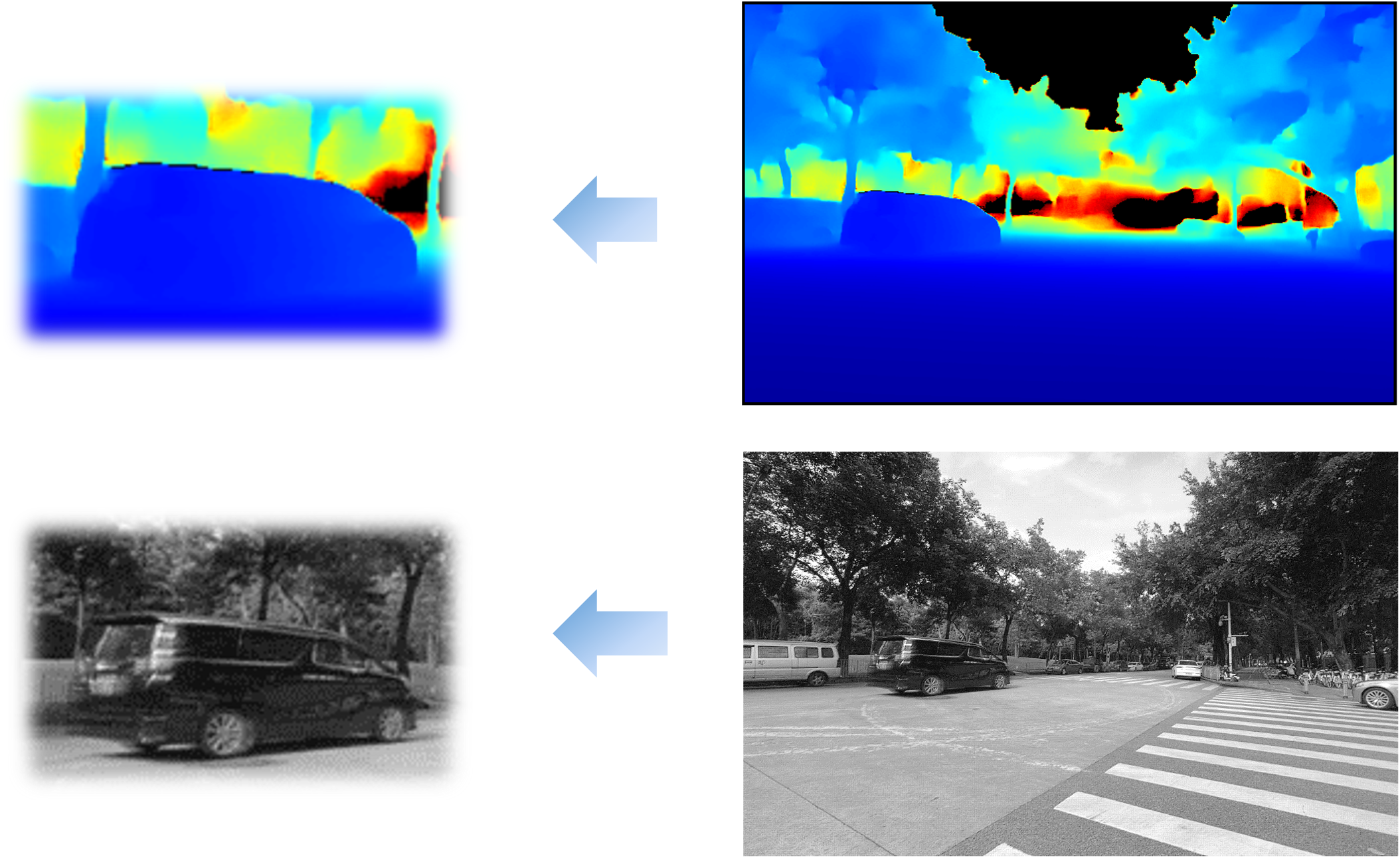
Some stereo depth cameras transmit raw image pairs to a host processor for depth computation. The compute load this creates is significant at high frame rates and resolutions, and it constrains the minimum host platform required to run the perception pipeline.
Orbbec’s Gemini 335 and 335L cameras use Orbbec’s custom MX6800 ASIC to perform depth computation and depth-to-color alignment inside the camera. The host receives a processed depth stream rather than raw stereo frame pairs. The practical consequence is that the camera can be paired with a less powerful host compute platform than would otherwise be required.
In-camera depth processing also reduces the overall processing latency within the perception pipeline. This can simplify system integration and reduce overall platform power consumption. For obstacle avoidance applications, minimizing total system latency between capture and control action is a relevant design constraint.
SDK and integration considerations
Depth camera integration in robotics deployments involves more than mechanical mounting and electrical connection. The SDK determines which platforms are supported, how the camera is addressed in the software stack, and what migration effort is involved if the camera is replaced.
The Orbbec SDK v2 is open source and actively maintained, with documented support for multiple platforms like Windows, Ubuntu, macOS, and Android. ROS and ROS2 wrappers are available, as are Python bindings. The Gemini 335L and Gemini 215 are confirmed as supported devices across all SDK v2 platform variants. For programs migrating from Microsoft Azure Kinect, Orbbec provides a K4A wrapper for the Femto Bolt and Femto Mega cameras that allows existing Azure Kinect applications to migrate with minimal code changes.
Hardware trigger synchronization is supported, enabling coordinated operation across multiple cameras in shared spaces. The Orbbec Perceptor Dev Kit (OPDK), as one reference implementation, uses four synchronized Gemini 335L cameras in a 360-degree configuration integrated with NVIDIA AGX Orin, providing a reference architecture for NVIDIA Isaac Perceptor deployments.
Deployment checklist: camera selection to production
The steps between selecting a depth camera and achieving stable production performance involve validation tasks that are often underestimated during the procurement phase.
Before pilot:
Validate that the selected camera meets the application’s fundamental environmental and integration requirements before beginning field evaluation.
- Define working distance range for each robot function. Measure the actual range in the deployment environment, not the design specification.
- Confirm IP rating against the specific environmental conditions: dust levels, humidity, temperature range, and any chemical exposure from floor cleaning.
- Verify SDK compatibility with the target host platform and operating system version before hardware procurement.
- If deploying multiple robots in shared aisles, confirm whether hardware trigger synchronization supports your requirements for synchronized capture, fleet coordination, and mitigation of IR emitter interference.
During pilot:
Focus on validating performance under representative operating conditions rather than ideal laboratory scenarios.
- Test depth accuracy at the minimum and maximum of the intended working range, not only at the datasheet reference distance.
- Validate performance under the full range of lighting conditions in the deployment environment, including shift changes, seasonal variation in skylight exposure, and high-contrast areas near loading dock doors.
- Assess calibration stability over the operating temperature range if the environment experiences significant seasonal variation.
Before production:
- Establish processes that ensure long-term consistency across fleet deployment and maintenance.
- Establish a fleet calibration procedure and schedule. Camera calibration drift is a real-world phenomenon that requires periodic maintenance.
- Confirm SDK version compatibility with the production OS and processor architecture. Version mismatches are a common source of delays between pilot and production.
- Document mounting configuration, thermal management requirements, and any application-specific tuning parameters before fleet-scale deployment.
Vendor evaluation: beyond specifications
Depth camera selection for a fleet deployment involves evaluating the vendor, not only the product. Sensors in mobile robotics platforms are expected to remain available and supported across operational lifetimes measured in years, not product cycles measured in months.
The factors relevant to long-term supply continuity include whether the vendor designs their own depth processing chips or integrates third-party silicon, factory production capacity, and whether the vendor has a documented track record of supporting migration paths when products reach end of life.
Orbbec designs its own depth processing ASICs across the stereo and structured-light product lines and operates its own manufacturing facilities for depth camera production. For programs evaluating long-term vendor risk in more depth, the supply chain continuity guide covers vendor evaluation criteria including vertical integration, manufacturing scale, and lifecycle transparency.
Frequently asked questions about warehouse automation & AMR navigation
What is the most important factor when selecting a depth camera for a warehouse AMR?
The application’s working distance, operating environment, and accuracy requirements should drive selection before any specific camera or technology is evaluated. A camera well suited to long-aisle pallet transport operates across a fundamentally different range and precision profile than one used for bin picking or tight-corner navigation. Defining those requirements first narrows the field more reliably than starting with a datasheet comparison.
What depth camera technology works best for warehouse automation?
It depends on the application. Active-passive stereo cameras handle the widest range of warehouse scenarios, including long-range navigation, variable lighting near dock doors, and outdoor staging areas, because the active IR illumination maintains performance where passive stereo and ToF can be susceptible to ambient light interference. ToF cameras are well suited to short-range indoor applications where lighting is controlled. LiDAR covers the longest ranges and works well in large outdoor yards, but carries higher per-unit cost and processing load than stereo for typical indoor AMR deployments.
How does stereo camera baseline width affect depth accuracy at range?
Stereo cameras triangulate depth from the disparity between two image sensors. A wider baseline improves the triangulation geometry at longer distances, which partially compensates for the natural accuracy degradation that occurs as working distance increases. For long-aisle applications where accurate depth at 10m or beyond matters, a wider baseline camera provides better precision at those distances than a compact narrow-baseline design.
What is in-camera depth processing, and why does it matter for AMR deployments?
Some stereo cameras transmit raw image pairs to a host processor for depth computation, which creates significant compute load at high frame rates. Cameras with onboard depth processing ASICs perform that computation inside the camera and deliver a processed depth stream to the host instead. The practical effect is a reduced host compute requirement, lower system power consumption, and lower latency between capture and control action. For obstacle avoidance applications, minimizing that latency is a relevant design constraint.
Can the same depth camera handle both navigation and bin picking on a single robot?
In most cases, no. Long-range navigation and close-range manipulation require fundamentally different optical configurations. A camera optimized for 20m navigation range will not deliver the sub-millimeter spatial precision needed for bin picking at 200mm to 500mm. Platforms that require both functions typically mount two separate sensors, each optimized for its specific working distance and precision requirements.
What does IP rating mean for warehouse camera selection, and which rating do I need?
IP rating indicates the level of protection against solid particles and liquids. For warehouse deployments that include exposure to floor cleaning chemicals, high humidity, loading dock areas, or outdoor staging, an IP65 rating provides protection against dust ingress and water jets. Indoor-only cameras rated for controlled conditions are not suitable for those environments and can fail prematurely if deployed there.
What SDK and software integration considerations apply to warehouse depth cameras?
The SDK determines which host platforms and operating systems are supported, how the camera interfaces with the perception pipeline, and what migration effort is required if the camera changes. Key questions before procurement: Does the SDK support your target host OS and processor architecture? Are ROS or ROS2 wrappers available for your robotics stack? If your program is migrating from another depth camera platform, are compatibility layers available to reduce integration effort? Confirming SDK compatibility before hardware procurement avoids version mismatch delays between pilot and production.
Start your warehouse vision project
Specific product pages for the cameras referenced in this guide:
- Gemini 335L: long-range stereo for navigation and industrial AMR deployments
- Gemini 215: short-range precision stereo for bin picking and close-range manipulation
- Orbbec SDK: open-source SDK documentation, ROS2, ROS, Python, and platform support
To discuss technical requirements for a specific deployment, contact Orbbec.