BEIJING, August 19, 2026 – On the opening day of the 2026 World Robot Conference (WRC) in Beijing, Orbbec held its “Multi-Dimensional Perception” new product launch event, marking the first full showcase of its Robot-Free Data Collection Hardware Platform and the official debut of the new Physis series robotics vision cameras.
The launches mark an important step in Orbbec’s expansion, built on more than a decade of expertise in robotics and AI vision, into two foundational infrastructure layers for physical AI. On the data side, the multimodal Robot-Free Data Collection Hardware Platform provides a hardware foundation for physical AI data collection, enabling high-quality real-world interaction data to flow more efficiently into model training and robot validation. On the perception side, Physis series equips embodied AI systems with more human-like visual perception, balancing wide-field imaging, high-quality image output, accurate spatial perception, and deployment-grade reliability.
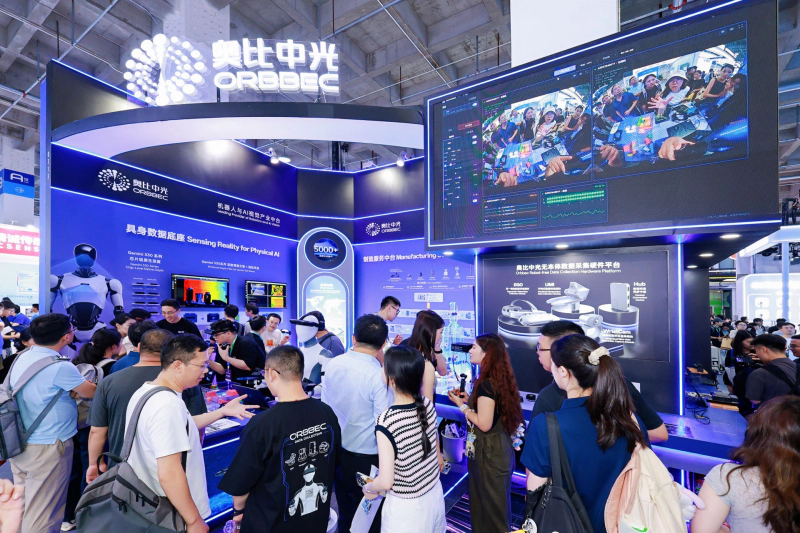
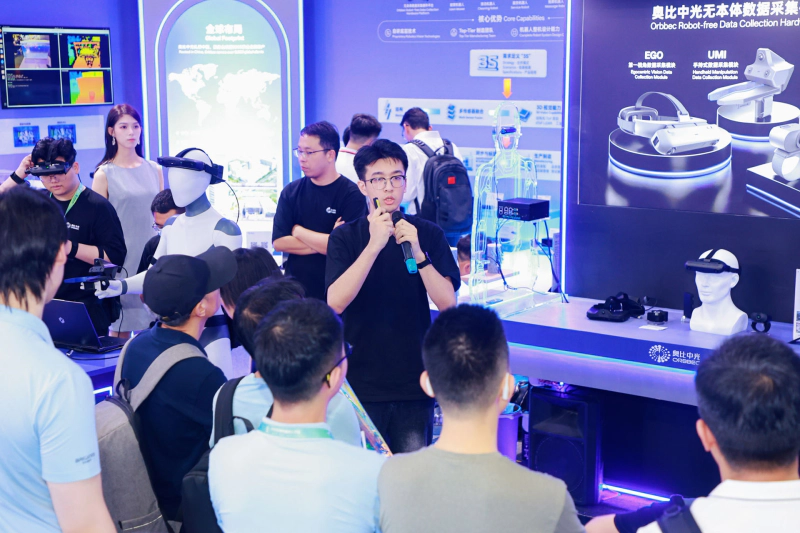
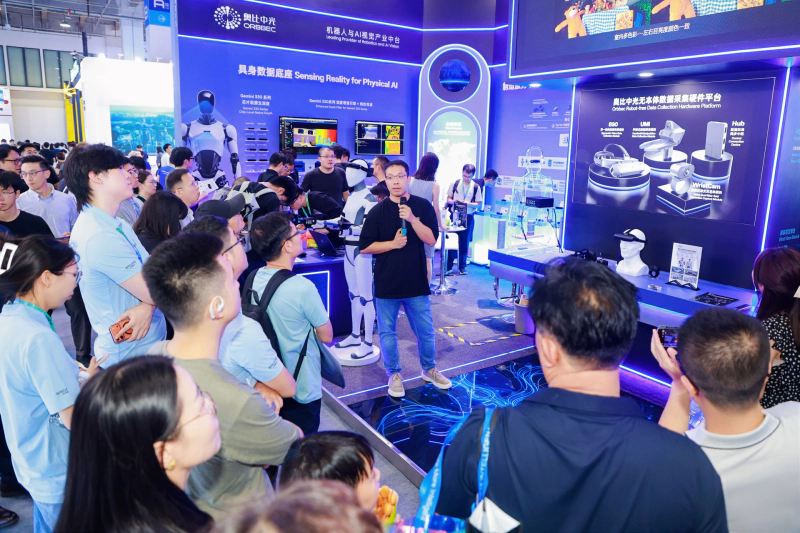
Orbbec’s “Multi-Dimensional Perception” new product launch event
A Full Lineup for Physical AI Data Collection: Built for Scalable Deployment
WRC 2026 marks the first complete showcase of Orbbec’s Robot-Free Data Collection Hardware Platform since its launch in July. The lineup brings together four product forms—EGO for first-person vision capture, UMI for handheld manipulation capture, WristCam for wrist-level near-field interaction capture, and Hub for central connection, forming a data collection matrix that covers the critical viewpoints of real-world interaction.
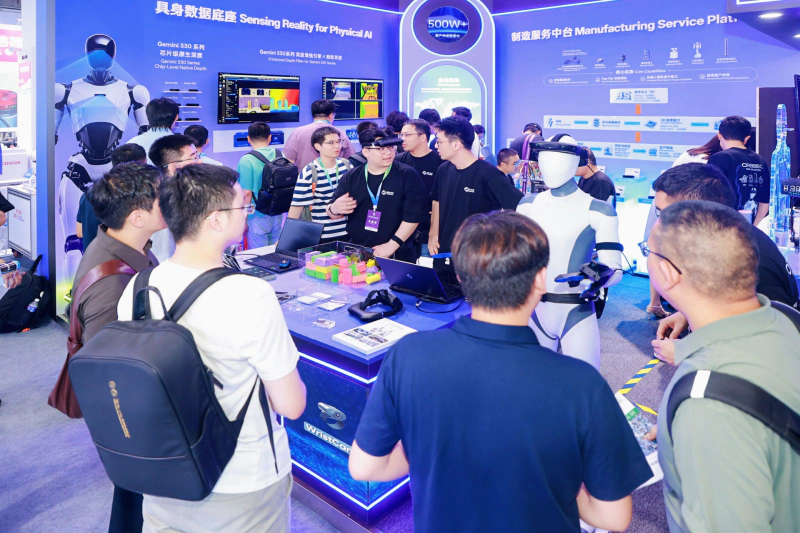
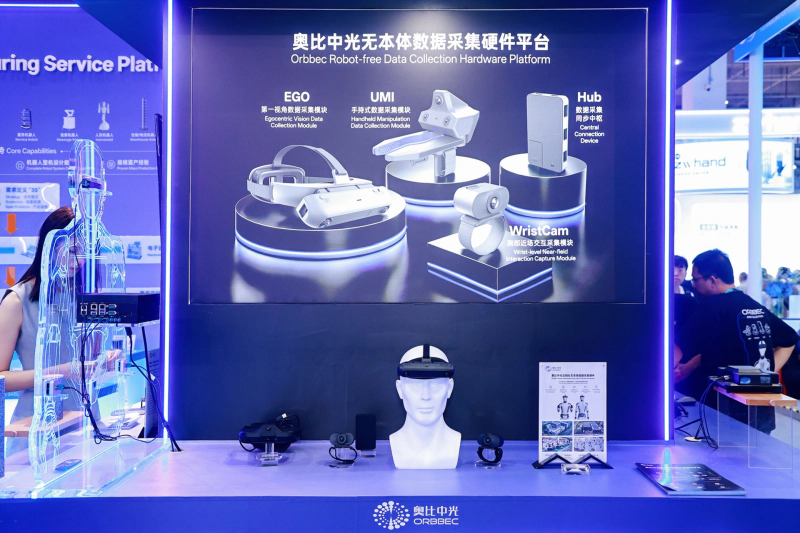
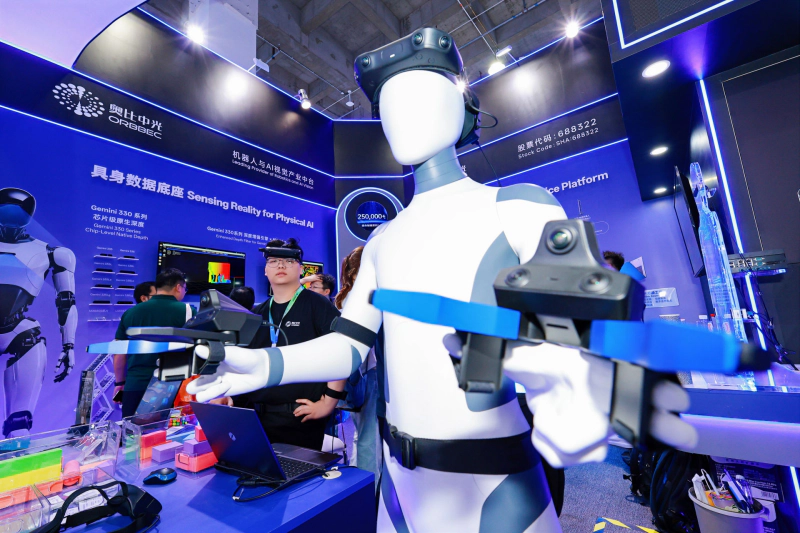
Live demonstration of Robot-Free Data Collection Hardware Platform
Complex interactions in real-world environments, such as diverse materials, changing lighting, occlusion, and a long tail of tasks, are essential yet scarce sources of data for the continuous learning of physical AI. To address this challenge, Orbbec has defined four core product capabilities for physical AI data collection: Real, Reliable, Rich, and Ready.
- Real: The starting point of data value. Real-world interaction data provides broad coverage of diverse materials, lighting conditions, occlusions, and long-tail operations.
- Reliable: The prerequisite for continuous data production. In production-line testing, Orbbec data collection devices recorded continuously for more than 37 hours at 1600 x 1200 @30 fps using H.264, with zero dropped frames across RGB and IMU streams and more than 100 million frames captured in total. Variation in camera-to-IMU frame intervals was kept within 30 microseconds, while low power consumption and stable thermal design supported sustained data collection.
- Rich: Precise multimodal alignment determines data quality. Through high-precision multisensor calibration and microsecond-level time synchronization, visual, tactile, audio, and video data are aligned in both space and time. Hardware-level multi-camera synchronization error is below 1 ms, and factory calibration error is below 0.3 pixels.
- Ready: Together, these capabilities support a shared objective: scalable, production-grade data delivery.
Backed by full-stack robotics and AI vision technologies alongside mature manufacturing capabilities, Orbbec positions its platform as the hardware foundation for physical AI data collection. It supports efficient and high-precision capture of real-world interaction data, hardware customization, and secondary software development. For data collection service providers, foundation model companies, robot manufacturers, and ecosystem partners in areas such as tactile sensing and data gloves, Orbbec offers standardized products, brand customization, contract manufacturing (CM), and joint design manufacturing (JDM) services.
The platform is already serving industry clients in China and international markets. “Orbbec provides more than data collection tools. It provides a unified hardware gateway that integrates core components upstream and serves model developers, robot manufacturers, and application partners downstream, working with the broader ecosystem to move physical AI from the laboratory toward deployment at scale,” said the Orbbec product lead. “Our goal is to bring physical-world data into model training and robot validation earlier, more completely, and faster.”
Physis Human-IPD RGB Stereo Vision: Closer to Human Vision, Built for Embodied AI
Data enables models to learn. When robots enter physical environments, vision becomes a critical interface connecting AI with the real world.
The newly launched Physis series robotics vision cameras address a fundamental challenge for embodied AI: how robots can acquire visual perception that more closely resembles human vision.
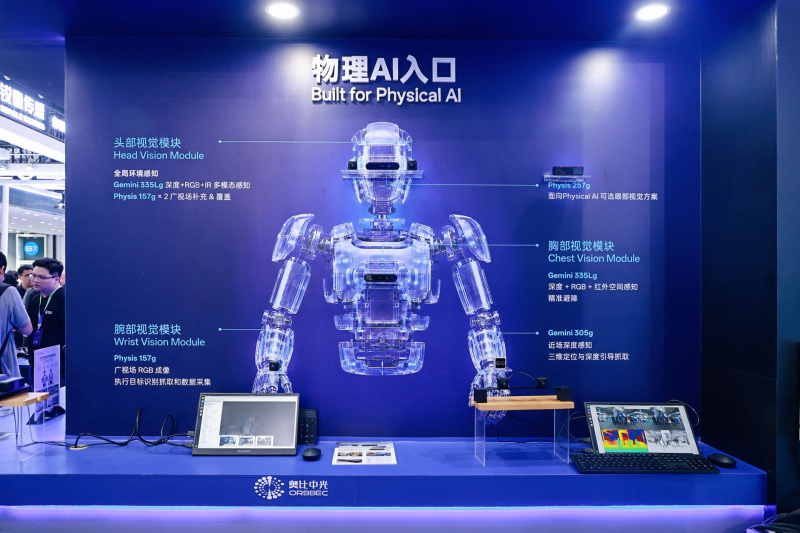
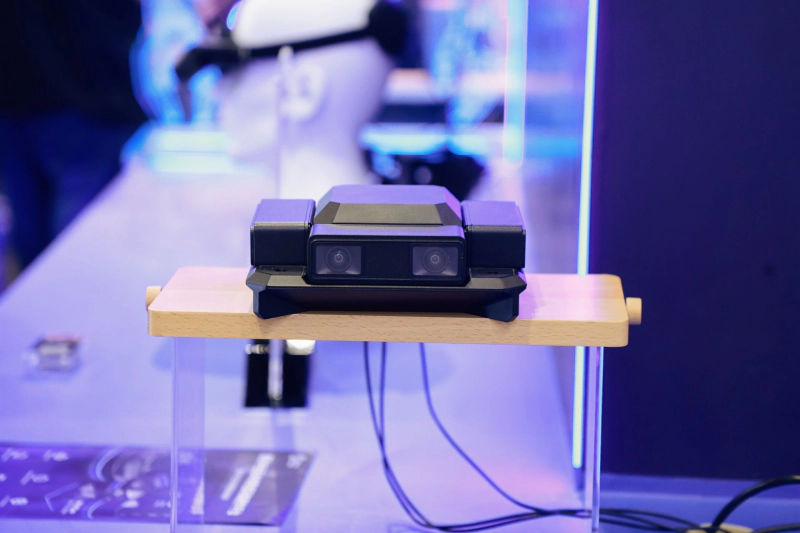
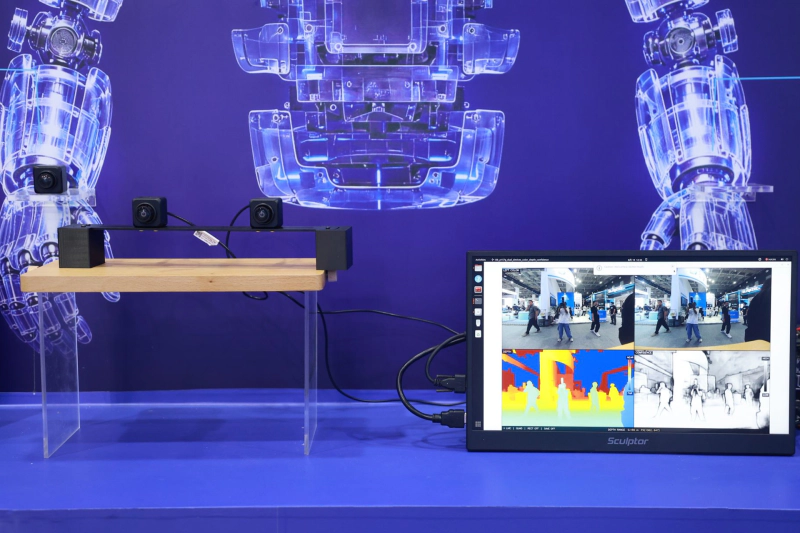
Live demonstration of Physis series robotics vision cameras
The first Physis products include the Physis 257g Human-IPD RGB stereo camera and the Physis 157g monocular RGB camera. Using passive imaging similar to the human visual system, the series captures visible light and natural textures while providing multimodal perception capabilities, including wide-FOV color and depth imaging.
The Physis 257g features the series’ proprietary natural-imaging system. Its 63 mm stereo baseline is close to the interpupillary distance of human eyes, while a low-distortion H120° x V90° field of view and dual real-time 1920 x 1200 @ 60 fps color streams deliver broad visual coverage. A global shutter and onboard ISP provide consistent color and texture across the stereo pair. Powered by the Orbbec SDK and a dedicated AI depth engine, the camera offers a depth sensing range from 0.1 m to beyond 10 m, with typical accuracy of 1.6% at 2 m, balancing wide coverage with high-quality depth. An integrated high-performance IMU provides multimodal support for robot visual localization.
Designed for demanding operating environments, the Physis 257g uses a high-speed GMSL2 interface, carries an IP67 rating, and operates across a wide temperature range from -30°C to 65°C. It is built to withstand the shocks and impacts associated with walking, obstacle traversal, running, and jumping. Combined with a low-latency hardware architecture, rich metadata, and globally unified timestamps, it provides an out-of-the-box solution for multi-camera synchronization and multimodal fusion.
The Physis 157g uses the same imaging specifications, hardware architecture, synchronization framework, and software design as the 257g, delivering high-quality color streams across the same wide field of view. A robot can use the 257g for core spatial, color, and texture perception, while adding the more compact 157g to expand multi-view coverage, enabling multiple cameras to share a common time base and imaging reference.
“Physis is purpose-built for humanoid robots, collaborative robot arms, and other embodied AI applications that require continuous, long-duration operation,” said an Orbbec product lead. “From multimodal perception in a single camera to fused perception across multi-camera systems, Physis is designed for the next stage of embodied AI: moving from ‘simply seeing’ to ‘seeing comprehensively, seeing accurately, and operating reliably.'”
Orbbec also introduced the new Gemini 338Le and Gemini 338Lg stereo 3D cameras. Both offer enhanced resistance to ambient-light interference. The Gemini 338Le uses an industrial-grade Gigabit Ethernet interface, while the Gemini 338Lg provides a high-speed GMSL2/FAKRA connection, addressing differentiated integration requirements in demanding industrial and logistics environments.
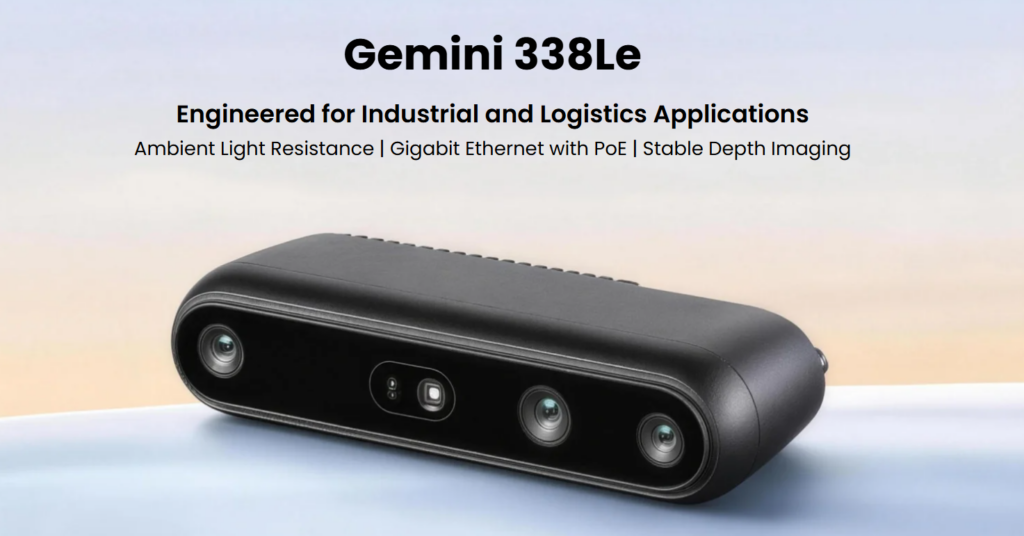
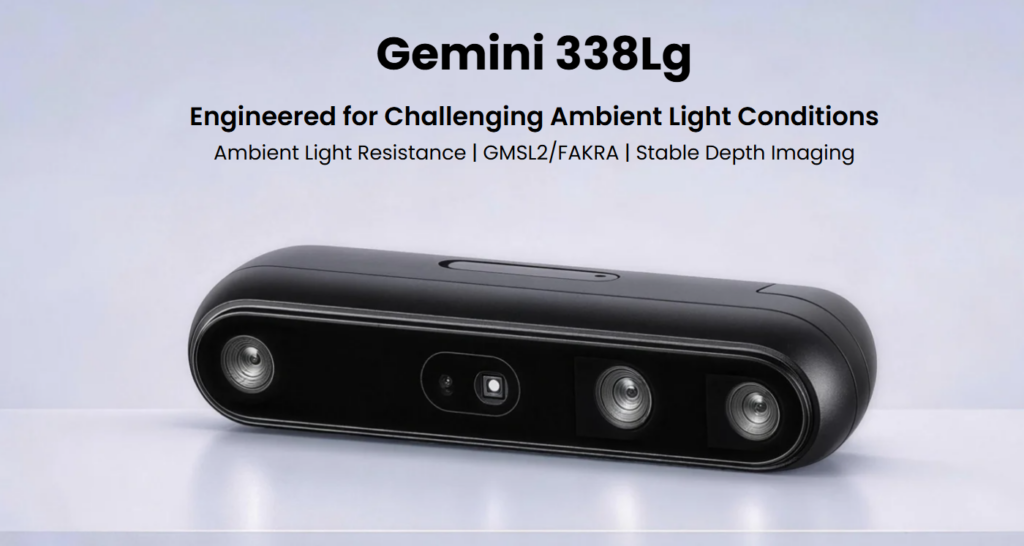
New Gemini 338Le and Gemini 338Lg stereo 3D cameras
Multi-Dimensional Perception: Connecting the Physical AI Pipeline from Data to Action
Data collection and robotics vision sit at opposite ends of the Physical AI pipeline, yet both face the same imperative: moving from technical validation to deployment at scale.
With full-stack capabilities spanning optics, chips, algorithms, and systems, as well as calibration, manufacturing, and volume delivery, Orbbec is connecting the complete chain from data and learning to action. The company will continue to collaborate openly with foundation model developers, robot manufacturers, data collection service providers, and other partners to co-build the physical AI data infrastructure and robotics industry ecosystem.
WRC 2026 runs through the afternoon of Aug. 23. During the event, Orbbec is showcasing its latest robotics vision and Physical AI data collection products at its main booth, B313. Orbbec products are also featured at the Robbyant booth (C111) and the Guangdong Embodied Intelligence Robotics Innovation Center booth (C132). D-Robotics is exhibiting at Orbbec’s main booth, as the two companies continue to deepen their “eye-brain synergy” collaboration on the integration of robotics vision and edge computing, platform adaptation, and application-specific deployment.
From 3:50 p.m. to 4:50 p.m. on Aug. 21, Dr. Howard Huang, Founder, Chairman, and CEO of Orbbec, will join leading industry guests at the WRC main forum in Yisheng Hall on the second floor (North) of the Conference Center for a discussion on how far world models are from delivering real-world value for humanity.