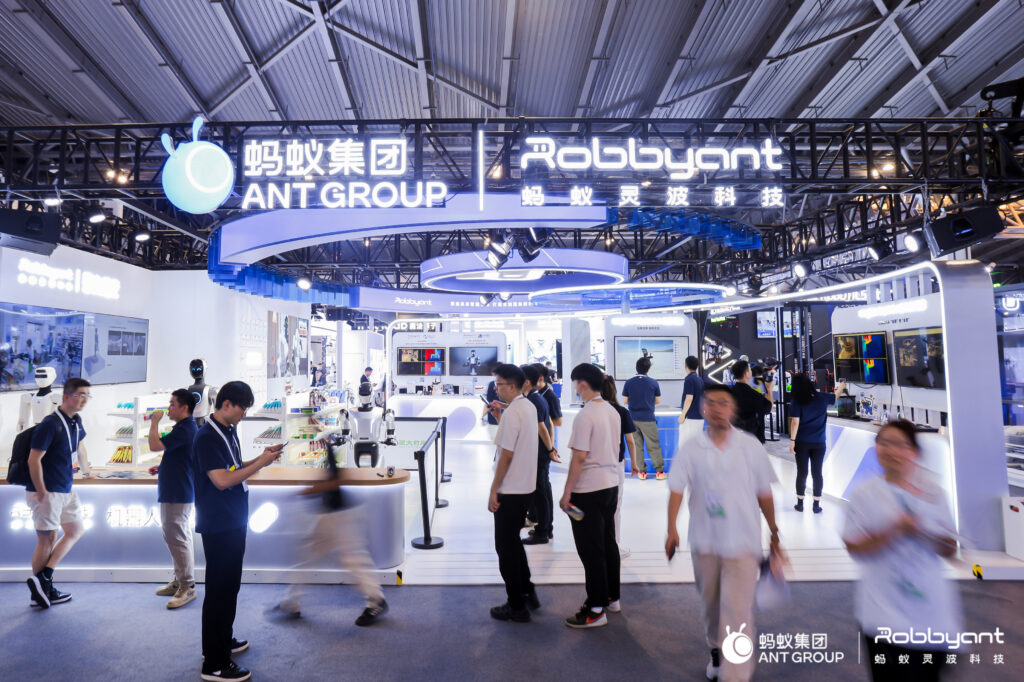
Shanghai, July 17, 2026 — The 2026 World Artificial Intelligence Conference (WAIC) opens today in Shanghai. At Robbyant LingBot Booth, Orbbec is showcasing the EGO RGB-D series, a core product series within its newly released Robot-Free Data Collection Hardware Platform.
Developed in collaboration with Robbyant, Ant Group’s embodied AI company, the solution combines chip-level native depth output from Orbbec’s 3D vision hardware with model-based depth enhancement powered by LingBot-Depth.
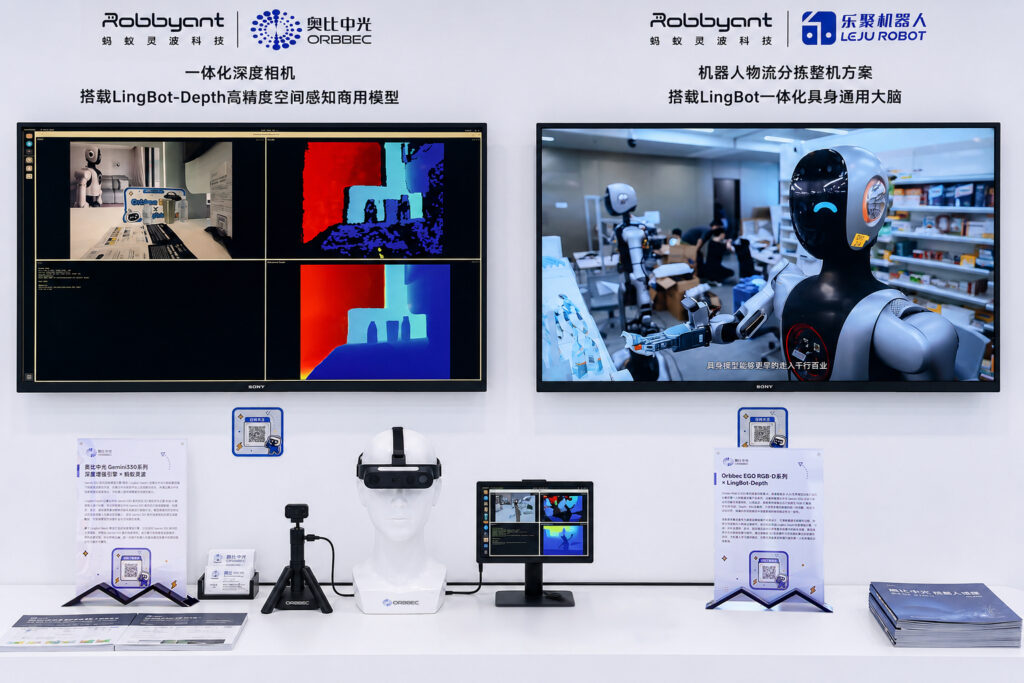
EGO RGB-D Makes Its Debut, Enabling Chip-Level Data Capture for Physical AI
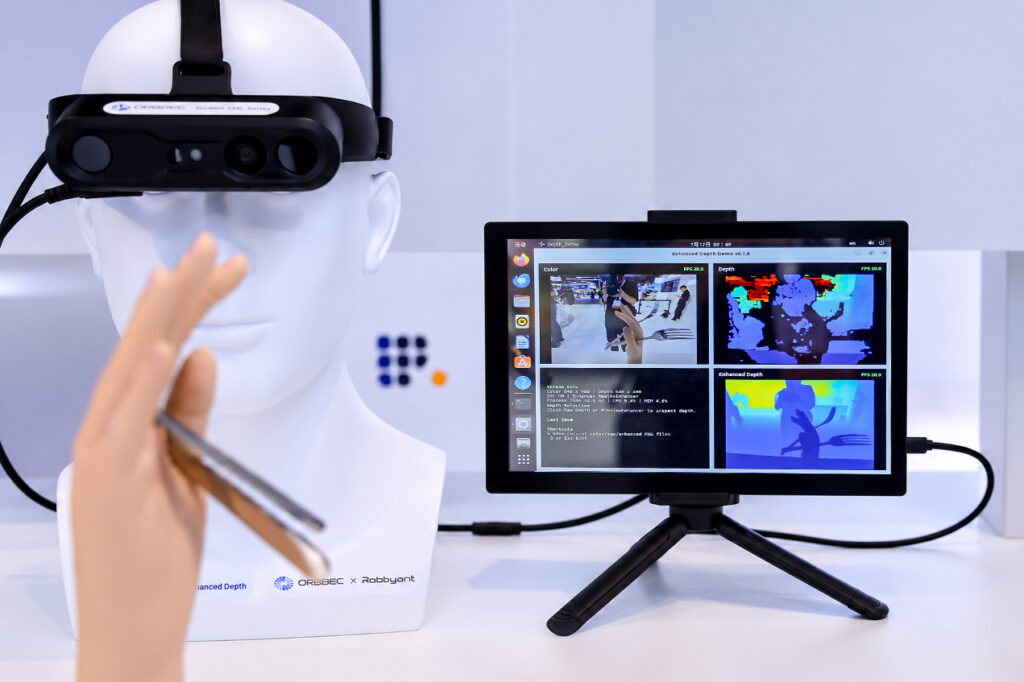
The Orbbec EGO RGB-D series is a line of head-mounted, first-person data collection products purpose-built for physical AI, embodied intelligence, and VLA/world model training, with a particular focus on tabletop fine-manipulation scenarios.
Built on Orbbec’s Gemini 330 series 3D cameras, the EGO RGB-D series uses the company’s proprietary MX6800 depth engine chip to perform onboard depth computation directly within the camera while synchronously capturing RGB, depth, and IMU data.
Unlike approaches that rely solely on depth estimated from RGB images, native RGB-D data preserves real-world metric scale while maintaining temporal synchronization, spatial alignment, and continuous, stable output.
The EGO RGB-D series is being adapted to a version of LingBot-Depth 2.0 specifically customized by Robbyant for data collection scenarios. Trained on a dataset of approximately 150 million samples and certified by Orbbec’s Depth Vision Laboratory, the model further completes missing depth information, refines object edges, and enhances spatial structure details.
Together, the hardware and the model provide two complementary layers of capability: Orbbec’s hardware delivers high-fidelity native depth data, while LingBot-Depth enhances challenging regions involving transparent objects, reflective materials, and occlusion boundaries.
Updated benchmark results show that the LingBot-Depth 2.0-based enhancement capability achieved the lowest root mean squared error (RMSE) in 12 of 16 test configurations, across real-sensor captures, block-masked depth inputs, and sparse-depth inputs.
On the ClearGrasp D415 transparent-object benchmark, RMSE was as low as 0.010, with 98.1% of evaluated pixels meeting the D105 accuracy threshold. On the DIODE-Indoor block-masked benchmark involving large areas of missing depth, RMSE decreased from 0.132 to 0.062, a reduction of approximately 53%.
These improvements translate into clearer object boundaries, more complete spatial structures, and more stable continuous data capture. They also allow transparent and reflective objects to be included in higher-quality RGB-D datasets, reducing data cleaning, repeated collection and manual rework.
Orbbec’s Robot-Free Data Collection Hardware Platform includes EGO, UMI, and WristCam product forms, covering first-person observation, wrist-level near-field observation and detailed hand-object interaction capture.
The platform supports physical AI model companies, robotics companies, data collection service providers, and data operators through standardized products, contract manufacturing and joint design manufacturing services.
LingBot Enhanced Depth Filter SDK Moves Toward Commercialization with Exclusive Authorization
At WAIC, Orbbec and Robbyant are also demonstrating the jointly developed LingBot Enhanced Depth Filter customized for the Gemini 330 series, available as an edge-side depth enhancement SDK exclusively authorized for commercialization.
The solution combines native depth data from Gemini 330 series cameras with the latest LingBot-Depth capabilities to reduce depth noise, fill missing depth regions and refine object boundaries. This improves robotic perception and operational reliability in complex real-world environments.
Orbbec also plans to launch an integrated camera featuring the commercial version of LingBot-Depth as early as the end of 2026, enabling all-in-one delivery of 3D camera hardware and spatial perception capabilities.
Based on Gemini 330 series cameras and LingBot-Depth enhancement capabilities, Orbbec is enabling a training-to-deployment RGB-D pipeline that connects physical AI data collection and model training with robot-side inference and deployment. Moving forward, Orbbec will continue combining 3D vision hardware and AI model capabilities to make real-world data more accurate, complete, and stable, accelerating physical AI from model training and validation to deployment at scale.
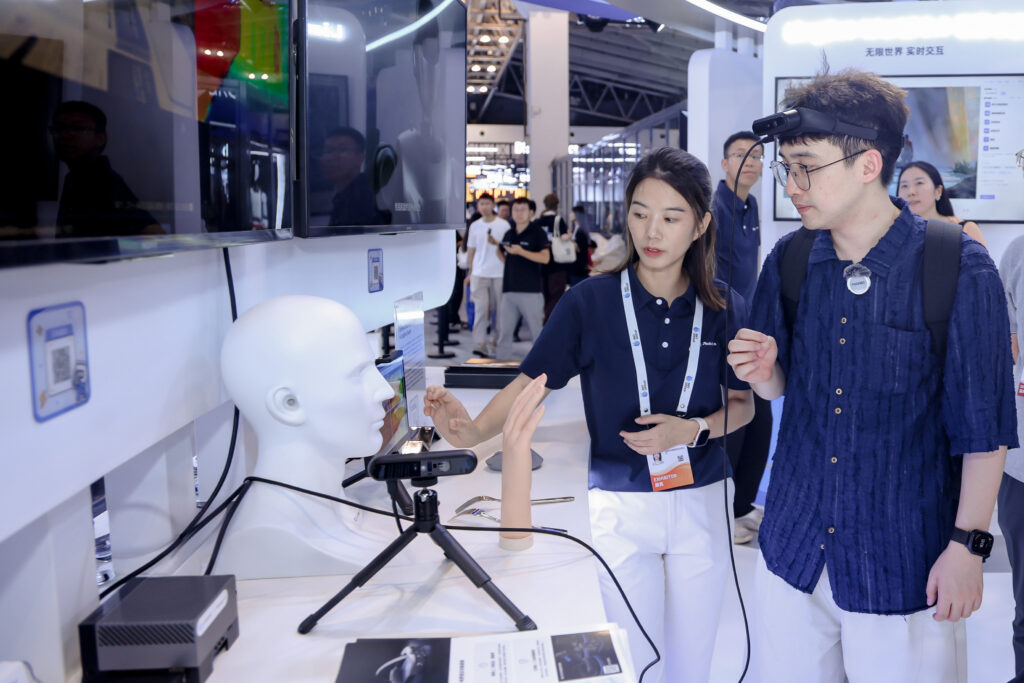
These solutions are on display at WAIC 2026, where visitors are getting a firsthand look at how robots perceive the physical world through live demonstrations using everyday objects such as a small transparent fish tank and glass cups. Visit Robbyant LingBot Booth (H3-B302) at the Shanghai World Expo Exhibition and Convention Center from July 17–20 to explore Orbbec’s latest innovations in data collection and edge AI-enhanced robot perception.
About ORBBEC:
Orbbec Inc. is a leading provider of robotics and AI vision. Using in-house chips and comprehensive system technologies, Orbbec provides high-performance 3D vision sensors and robotics and AI vision solutions for industries such as robotics, 3D scanning, and biometrics, as well as for developers around the world. Orbbec offers a comprehensive suite of “R&D and manufacturing” solutions to over 5,000 global clients and developers across nearly 100 countries and regions.