Selecting a depth-sensing technology is a critical system-level decision in robotics and vision applications. The choice between speckle projection structured light (SP structured light, as used in the Orbbec Astra series) and indirect time-of-flight (iToF, as used in the Orbbec Femto series) affects measurement accuracy, real-time performance, environmental robustness, and system complexity.
These technologies rely on different sensing principles and exhibit distinct trade-offs across illumination conditions, operating environments, motion dynamics, and integration constraints. As a result, no single approach is universally optimal. Performance depends on how well the technology aligns with specific application requirements.
This guide provides an engineering-focused framework for evaluating SP structured light and iToF systems, helping you select the most appropriate solution for real-world deployment.
- How Structured Light and iToF Depth Cameras Work
- How to Choose Between Structured Light and iToF
- Which Applications Use Structured Light vs. iToF?
- Application Requirements Checklist
- Integration and Total Cost Considerations
- Hybrid Depth Sensing: Combining Structured Light, iToF, and LiDAR
- Depth Sensing Technology Trends in Robotics and Embedded Vision
- Partner With 3D Vision Experts From Silicon to Deployment
- Frequently Asked Questions
How Structured Light and iToF Depth Cameras Work
SP structured light and iToF systems rely on active depth sensing, projecting infrared illumination onto a scene and analyzing reflected light to calculate distance. While both technologies generate depth maps, their sensing mechanisms lead to distinct performance characteristics in real-world applications.
SP structured light systems project infrared speckle patterns onto a target surface and calculate depth by comparing captured speckle images with a calibrated reference pattern via image correlation. This approach enables high depth resolution and detailed surface reconstruction near the calibrated operating distance.
In practice, this leads to the following characteristics.
- High spatial resolution, which is well-suited for applications requiring fine detail and precision measurement.
- Projected texture dependence, which creates sensitivity to ambient light and infrared interference, especially in outdoor environments.
- Reference-distance-dependent accuracy, which peaks near the calibration distance and degrades as objects move farther away.
- Triangulation geometry, which delivers strong performance at short to midrange distances.
- Limited effective projection coverage, which can introduce shadow regions and incomplete depth data in complex scenes.
iToF depth cameras measure depth by calculating the phase shift of emitted light returning to the sensor. Because iToF calculates at the pixel level without image correlation, it enables stable. real-time depth acquisition across dynamic scenes.
In real-world systems, iToF typically exhibits:
- Single-shot depth capture to support real-time operation and dynamic scene tracking.
- Consistent performance over distance to maintain stable depth output within its working range.
- Reduced dependence on scene texture, enabling more robust operation in outdoor or variable lighting conditions.
- Susceptibility to multipath interference (MPI) from reflective or complex surfaces, which introduces inaccurate depth measurements or artifacts.
How to Choose Between Structured Light and iToF
Given the fundamental differences between SP structured light and iToF systems, selecting the appropriate depth-sensing technology requires a systematic evaluation of application constraints, performance requirements, and deployment conditions.
A structured evaluation typically includes the following dimensions.
- Define performance requirements: Establish minimum acceptable values for depth accuracy, resolution, frame rate, and working distance range.
- Characterize the operating environment: Document illumination conditions, temperature ranges, surface material properties, and environmental protection requirements.
- Assess integration constraints: Evaluate available space, power budget, processing capability, and mechanical stability.
- Evaluate total cost of ownership: Factor component costs, integration complexity, calibration requirements, and long-term maintenance.
- Validate through prototyping: Test candidate technologies under representative conditions before committing to volume production.
In addition to system-level evaluation, the following questions clarify technology fit:
- Does your application require high depth accuracy or precision at a defined operating distance? SP structured light provides high depth resolution, accuracy, and precision near the calibrated working range. iToF delivers more consistent depth performance across varying distances.
- Will the system operate in outdoor or variable lighting environments? iToF is more tolerant of ambient light variations, while SP structured light depends on the visibility of projected speckles and controlled infrared conditions.
- Is stable real-time depth acquisition required in dynamic environments? iToF performs direct pixel-level depth measurement and maintains stable depth acquisition under motion. SP structured light can experience reduced correlation stability when rapid movement or changing scene conditions degrade projected speckle patterns.
Which Applications Use Structured Light vs. iToF?
Selecting between SP structured light and iToF depends on balancing application requirements, operating conditions, and system-level deployment constraints.
Manufacturing and quality inspection
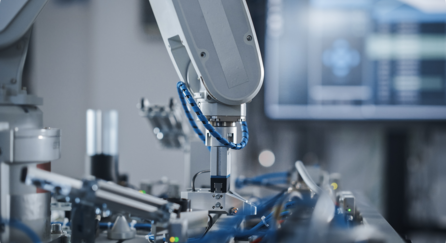
SP structured light systems are well-suited for controlled industrial inspection environments requiring high depth resolution and fine surface detail capture. Applications such as PCB inspection, dimensional verification, and surface defect detection benefit from high-precision depth measurement at fixed operating distances.
Robotics and automation
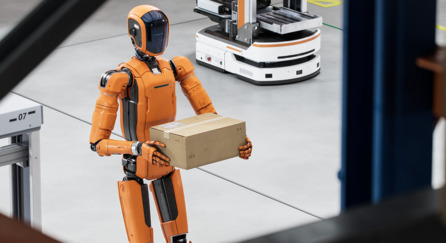
iToF systems are commonly used in robotics and automation applications requiring stable real-time depth acquisition across variable distances and dynamic environments. Autonomous mobile robots, obstacle–avoidance systems, and robotic manipulation platforms benefit from iToF’s consistent depth performance and reduced sensitivity to ambient lighting variation.
Human-machine interaction
Human-machine interaction applications prioritize low latency, stable body tracking, and real-time responsiveness. iToF systems are excellent for gesture recognition, occupancy sensing, automotive cabin monitoring, and interactive kiosk applications due to their stable, real-time depth acquisition and full-scene depth capture.
3D scanning technology and modeling
3D scanning and digital reconstruction applications often prioritize fine surface detail and geometric fidelity. SP structured light systems are ideal for reverse engineering, heritage preservation, and high-precision object scanning at short operating distances. By contrast, iToF systems are suitable for large-scene or fast-acquisition workflows where capture speed and operational flexibility are higher priorities than fine surface detail.
Mobile and embedded devices
Mobile and embedded platforms often prioritize compact integration, thermal efficiency, and low system complexity. iToF systems are commonly adopted in space-constrained and battery-powered devices because of their stable real-time performance and simplified sensing pipeline. In industrial embedded systems, deployment requirements such as operating range, thermal conditions, and precision requirements are more important than sensing technology alone.
Application Requirements Checklist
Before finalizing technology selection, verify:
- Minimum and maximum working distance requirements
- Required depth resolution and measurement accuracy
- Target frame rate for real-time processing
- Surface material types and optical properties
- Ambient lighting conditions and variability
- Available power budget and thermal headroom
- Integration space and mechanical stability
- Software development resources and SDK requirements
- Calibration maintenance capabilities
- Production volume and supply chain considerations
Performance Characteristics and Trade-Offs
Understanding the trade-offs between structured light vs. iToF technologies requires examining how their underlying sensing approaches translate into performance characteristics in real projects.
Accuracy and Resolution
SP structured light systems deliver high depth resolution and fine surface detail at short range, making them well-suited for precision measurement and high-fidelity 3D reconstruction. However, performance hinges on working distance, with depth accuracy degrading as objects move away from the calibrated operating range. Projector and sensor field-of-view mismatch can also introduce shadow regions and incomplete depth coverage in complex scenes.
iToF systems provide moderate depth resolution while maintaining more consistent depth performance across their operating range. This dependability makes them better suited for dynamic environments and real-time robotic applications where robustness and coverage are higher priorities than fine surface detail.
Real-Time Performance and Dynamic Scenes
SP structured light systems can achieve real-time depth acquisition through single-frame image correlation. However, depth stability depends heavily on the visibility and quality of the projected infrared speckle pattern, which can degrade under fast motion, low-reflectivity surfaces, or strong ambient lighting conditions.
iToF systems capture depth information at the sensor level. They maintain stable real-time performance in dynamic environments with reduced dependence on projected pattern quality and image correlation stability. They are well-suited for mobile robotics, gesture tracking, and fast-response applications.
Environmental Robustness
Environmental operating conditions include temperature ranges, power stability, interface requirements, and ingress protection ratings. These conditions influence long-term system stability in real-world deployments. Among these factors, ambient lighting conditions and target surface properties have the greatest impact on depth sensing performance.
SP structured light systems depend on projected infrared speckle visibility. The projected pattern can wash out under bright sunlight or strong ambient infrared interference, reducing image correlation quality and making depth reconstruction unreliable in uncontrolled lighting conditions.
iToF systems generally demonstrate greater tolerance to ambient light variation through modulated active illumination. However, reflective or geometrically complex surfaces can introduce MPI, resulting in inaccurate depth measurements or artifacts.
Power Consumption
Multiple factors affect power consumption in depth sensing systems, which include:
- Illumination intensity
- Sensing architecture
- Onboard processing
- Operating range
- Frame rate requirements
In embedded and battery-powered robotics platforms, thermal constraints, compute workload, and system efficiency are as important as sensor-level power consumption.
Because real-world power behavior depends on application requirements and system design, it’s critical to evaluate power consumption at the system level rather than relying solely on sensing technology.
Integration and Total Cost Considerations
Evaluating depth-sensing technologies solely on specifications often overlooks the hidden engineering costs associated with real-world deployment. Across robotics and embedded vision applications, integration complexity, calibration workflow, synchronization requirements, and software development effort can impact project cost and deployment timeline.
System-level factors such as multicamera calibration, platform compatibility, compute architecture, thermal constraints, and long-term maintenance all influence deployment scalability and operational reliability. These engineering considerations have a greater impact on total system cost than the sensor hardware itself.
Robust SDK and developer resources, calibration tools, cross-platform software compatibility, and long-term technical support can reduce development overhead and accelerate system integration. For large-scale or long-lifecycle deployments, maintainability, firmware consistency, and component availability can minimize operational risk.
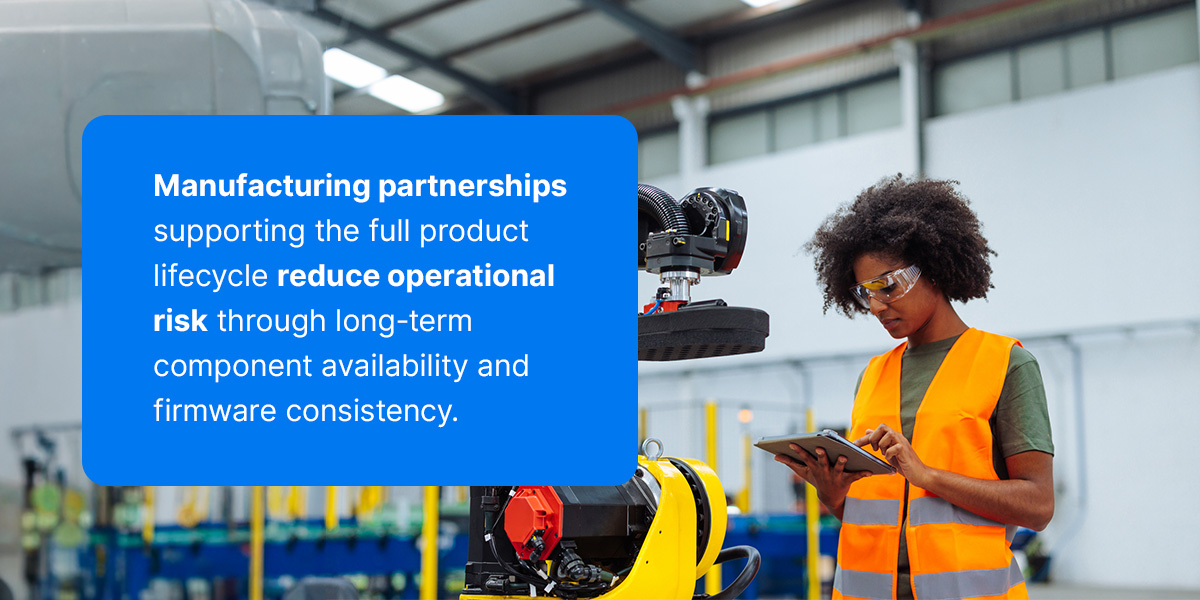
Manufacturing partnerships supporting the full product lifecycle reduce operational risk through long-term component availability and firmware consistency. They also ensure continued access to technical integration support throughout deployment and maintenance phases.
Hybrid Depth Sensing: Combining Structured Light, iToF, and LiDAR
As robotics and vision systems become more complex, hybrid sensing architectures increasingly combine the strengths of multiple technologies within a single perception system, including SP structured light, iToF, stereo vision, and LiDAR.
In practical deployments, SP structured light may be the best choice for high-resolution short-range measurement, while iToF, stereo vision, or LiDAR provide stable depth acquisition over larger operating distances or dynamic environments. Multisensor fusion approaches can improve coverage, robustness, and operational reliability in applications involving varying surface materials, changing lighting conditions, or complex workspace geometry.
Depth Sensing Technology Trends in Robotics and Embedded Vision
Future depth-sensing development focuses on tighter integration between sensing, processing, and system-level perception. Emerging architectures combine onboard depth computation, sensor fusion, and embedded AI processing. These features reduce latency, simplify integration, and improve deployment efficiency in robotics and embedded vision systems.
As robotics and AI systems continue to evolve toward more complex deployments, depth-sensing technologies will face increasing demands for performance, scalability, and system integration. These trends create new opportunities and engineering challenges for vision system providers such as Orbbec, particularly in multi-sensor coordination, embedded perception, and long-term deployment reliability.
Partner With 3D Vision Experts From Silicon to Deployment
Selecting depth-sensing technology involves far more than comparing sensor specifications. Real-world deployment requires balancing measurement performance, operating conditions, and system integration complexity. Balancing scalability, product quality control, and long-term maintenance considerations across the entire vision pipeline further supports deployment. These trade-offs become even more challenging under tight budget constraints, where system architecture decisions can impact development cost, deployment efficiency, and long-term serviceability.
Orbbec provides a full-stack 3D vision ecosystem spanning sensors, silicon, algorithms, embedded AI, manufacturing, and technical support. We help customers accelerate development from prototype to production deployment. Our engineering teams combine hands-on experience across robotics, manufacturing, healthcare, and embedded vision applications to support off-the-shelf integration and JDM system development throughout the complete product lifecycle, including product quality management and long-term after-sales support.
Whether you’re developing autonomous mobile robots, industrial automation systems, or healthcare robotics, our experts can help you select the ideal stereo vision solution for your application.
Frequently Asked Questions
Can structured light cameras be used outdoors?
SP structured light systems depend on the visibility of projected infrared speckle patterns, which can wash out under bright sunlight or strong ambient infrared. Outdoor use is generally unreliable. iToF systems are more tolerant of ambient light variation and are better suited for outdoor or variable-lighting environments.
Is iToF accurate enough for manufacturing inspection?
iToF provides consistent depth performance across its operating range but at moderate resolution. Applications requiring high depth resolution and fine surface detail at a fixed operating distance — such as PCB inspection or dimensional verification — are better served by SP structured light.
What causes depth artifacts in iToF cameras?
The primary cause is multipath interference (MPI), which occurs when emitted light reflects off multiple surfaces before returning to the sensor. Reflective, concave, or geometrically complex surfaces are the most common sources of MPI-related artifacts.
What depth camera is best for robotics?
Most mobile robotics applications use iToF or stereo vision cameras because of their stable real-time performance across variable distances and lighting conditions. iToF is well-suited for obstacle avoidance, AMR navigation, and human-machine interaction. Fixed-position industrial robots in controlled environments can also use SP structured light where high precision at a defined working distance is required.
What is the difference between structured light and time-of-flight cameras?
Structured light cameras calculate depth by projecting a known infrared pattern onto a surface and comparing the captured image against a calibrated reference. Time-of-flight cameras measure depth by calculating the phase shift of emitted infrared light returning to the sensor. Structured light delivers higher resolution at short, calibrated distances. Time-of-flight provides more consistent depth output across a range of distances and performs better in dynamic environments.
Linked Sources:
- https://www.orbbec.com/products/structured-light-camera/astra-series/
- https://www.orbbec.com/products/tof-camera/femto/
- https://hammer.osu.edu/media/document/2023-12-21/09_2023_structured-light-scanning-artifact.pdf
- https://link.springer.com/article/10.1007/s00138-016-0784-4
- https://www.orbbec.com/blog/guide-to-3d-vision-technology-specifications/
- https://hammer.osu.edu/media/document/2023-12-21/09_2023_structured-light-scanning-artifact.pdf
- https://www.orbbec.com/products/tof-camera/femto/
- https://store.orbbec.com/products/gemini-215
- https://www.orbbec.com/resources/
- https://www.orbbec.com/odm-services/
- https://www.orbbec.com/company/
- https://www.orbbec.com/industries/