Human-machine interaction (HMI) is transforming with the help of advanced perception systems, which bridge the gap between machine sensing and true understanding of human intent. As industrial environments become more dynamic and collaborative, the ability of machines to move beyond simple object detection toward context-aware computing is critical.
For engineers, researchers, and technology decision-makers focused on automation and robotics, mastering the stack of technologies driving this transformation is now essential for delivering robust, adaptive, and safe human-centric solutions.
What Advanced Perception Means in Modern HMI
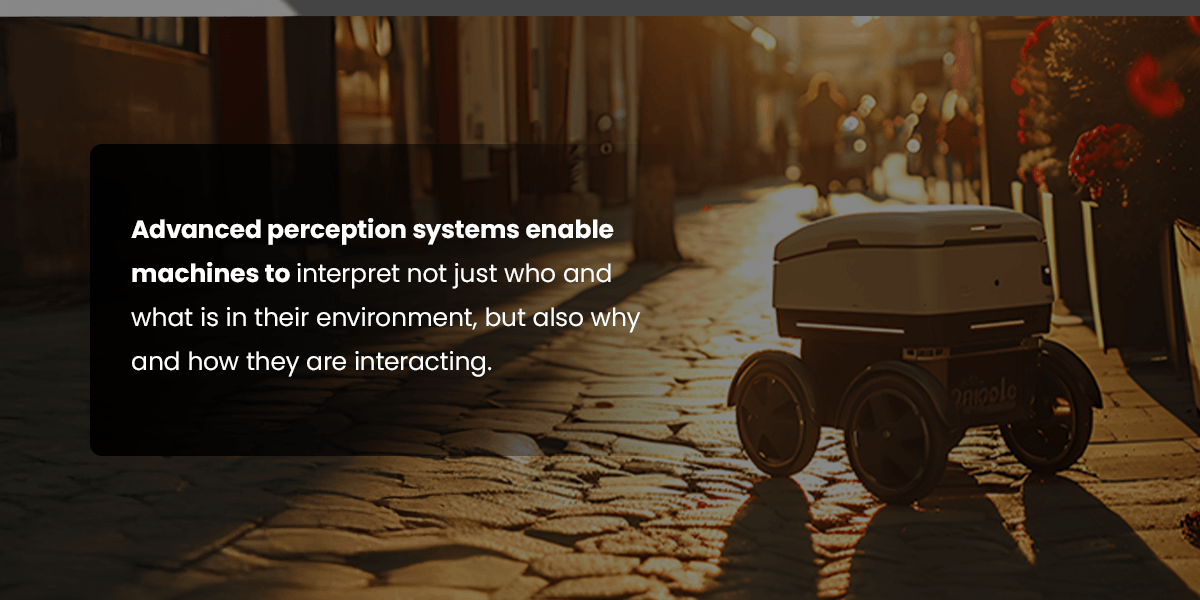
The role of perception in HMI is no longer limited to passive data gathering. It has evolved into a sophisticated, multi-layered process capable of proactive decision-making. Advanced perception systems enable machines to interpret not just who and what is in their environment, but also why and how they are interacting.
Perception Systems: From Sensing to Action
Perception systems can be understood as a “stack,” each layer delivering increasing value. At each stage, the system refines information, allowing machines to complete informed and adaptive behavior. Take a look at the layered approach:
1. Sensing: This layer captures raw data using sensors such as cameras, LiDAR, or depth modules.
2. Perception: Perception involves processing raw data to detect relevant features such as objects, people, or obstacles.
3. Interpretation: Systems infer the context and meaning to determine which actions are likely or safe based on the machine’s understanding.
4. Interaction: Finally, the interaction layer executes decisions or adapts behavior, closing the loop between perception and action.
While traditional systems might “see” pixels, true HMI requires the ability to extract semantic meaning. This ensures machines grasp the intent behind human actions. It allows for new forms of collaboration, where commands are replaced by nuanced understanding. This functionality enables shared autonomy, dynamic safety zones, and adaptive interfaces tailored to human intent and context.
Depth Sensing Foundations and Why 3D Changes HMI
Historically, most HMI systems relied on 2D cameras. While effective for basic tasks, 2D imaging struggles with critical spatial understanding. Challenges such as depth ambiguity, occlusions, or object volume estimation are often insurmountable, increasing the risk of errors or unsafe interactions in complex industrial settings.
Depth image processing delivers reliability in demanding industrial environments. It provides the accuracy and redundancy essential for safety-critical HMI applications such as robot cells and collaborative workspaces.
Modern depth-sensing technologies provide robust 3D data. Key modalities include:
- Active stereo vision uses structured light or infrared patterns to enable fine-grained depth estimation. This capability is suitable for shorter ranges but can struggle in direct sunlight.
- Time-of-Flight measures phase shift in reflected light to deliver consistent results over longer ranges and diverse lighting conditions. It may consume more power.
3D Object Detection and Recognition for Interaction
3D object detection locates where an object is in 3D space, while 3D object recognition identifies what the object is. Both capabilities are essential for effective human-machine interaction. They allow a system to perceive its surroundings and react appropriately to the objects within.
Detection and recognition work together to give machines the awareness needed to make safe and efficient decisions. Systems can adapt behavior based on object recognition to enhance productivity and safety, such as prioritizing a moving part over a stationary fixture.
This information aids several manufacturing applications, including bin picking, tool verification, and 3D model mapping for creating digital twins. Additional information, including position and orientation, is crucial for many applications. For example, pose estimation is important for robotic grasping and human-robot handovers, where spatial alignment must be exact to avoid collisions and ensure intuitive cooperation.
Semantic Segmentation and Scene Understanding
Semantic segmentation involves labeling each pixel or point to categorize regions within a scene. This process allows the system to distinguish between various elements, such as floors, machines, and humans.
Segmentation also provides essential data for high-level control policies. For example, policies may include stopping if the system detects a human nearby or stopping if an obstruction is blocking the path. Maintaining accurate segmentation is often a technical challenge, but robust 3D perception aids in addressing it.
Human Presence Detection and Real-Time Tracking
Modern HMI systems must go beyond basic human presence detection to truly understand human activity and intent. Advanced perception enables machines to interpret whether a person is present and what they are doing or how they intend to interact. Fundamental advancements are:
- Skeletal tracking to track human joint positions and movement, allowing systems to interpret body language and gestures.
- Hand and gesture recognition to enable more granular control, such as recognizing pointing or waving to trigger machine responses.
- Intent inference to analyze posture and movement to anticipate user actions and adapt accordingly.
Multi-Camera Sync and Coverage at Scale
In complex environments, a single camera often cannot provide complete coverage or avoid blind spots. Deploying multiple synchronized cameras addresses these gaps and ensures robust perception at scale. The benefits of multi-camera setups include:
- Elimination of occlusion: Multiple views ensure every angle is covered, minimizing the risk of missed detections when objects or people are out of line-of-sight.
- Expanded coverage: Larger or irregular spaces can be monitored continuously, enabling precise tracking everywhere it matters.
- Enhanced confidence: By investing in multi-camera perception systems, organizations ensure no critical events go unnoticed, and operators work alongside machines with greater confidence.
Context Awareness in Computing
Context incorporates the system’s awareness of the user’s state, the task’s phases, and the physical environment. Context-aware systems continuously acquire sensor data, model the current scenarios, reason about likely human intentions, and adapt in real time.
This intelligence allows systems to pause actions if a user looks away, offer the right tool at the right time, or adapt interfaces when detecting a hand. While simple rules, such as “if, then” rules, still have utility, modern systems increasingly use AI to infer intent, delivering richer, context-sensitive interactions.
Application Spotlights: AR, Safety, and Beyond
Here are some ways advanced vision systems are creating safer and more intuitive user experiences:
- Augmented reality cameras: An augmented reality camera uses depth-enhanced AR to anchor digital content to the physical environment, supporting training and maintenance with overlays registered to real-world equipment.
- Fall prevention technology: 3D skeleton tracking supports fall detection and prevention by monitoring gait patterns, detecting slips, and issuing alerts in real time.
- Smart appliances: Consumer and commercial products increasingly use context-aware perception for gesture controls and adaptive interfaces, improving ease of use and accessibility.
Choosing the right 3D machine vision software is critical for aligning hardware capabilities with application requirements. When evaluating advanced perception for your HMI or robotics project, consider the required working range and field of view, illumination and environment complexity, latency and responsiveness needs, and integration with existing software and safety systems.
Next Steps: Building an Advanced Perception System
Selecting the right 3D vision solution is pivotal. You can ensure your next HMI project meets the demands of tomorrow’s context-aware workplaces by discussing your unique requirements with Orbbec.
Orbbec’s full stack offers an end-to-end platform for rapid deployment of advanced perception solutions, reducing integration risk and accelerating time to value. Request a consultation to receive tailored recommendations.

Frequently Asked Questions
Q1: What is an advanced perception system in human-machine interaction?
An advanced perception system is a multi-layered technology stack that enables machines to move beyond simple data gathering toward proactive decision-making. It consists of four layers: sensing (capturing raw data), perception (detecting objects and people), interpretation (inferring context and meaning), and interaction (executing decisions). This allows machines to understand not just who and what is in their environment, but also why and how they are interacting—enabling shared autonomy, dynamic safety zones, and adaptive interfaces tailored to human intent.
Q2: Why is 3D depth sensing better than 2D imaging for human-machine interaction?
While 2D cameras work for basic tasks, they struggle with critical spatial understanding challenges such as depth ambiguity, occlusions, and object volume estimation. These limitations increase the risk of errors or unsafe interactions in complex industrial settings. 3D depth sensing delivers the accuracy and redundancy essential for safety-critical HMI applications like robot cells and collaborative workspaces, enabling machines to accurately measure, recognize, and interact with their surroundings.
Q3: What are the main depth-sensing technologies and when should each be used?
There are three primary depth-sensing technologies: Active Stereo Vision uses structured light or infrared patterns for fine-grained depth estimation, suitable for shorter ranges but may struggle in direct sunlight. Time-of-Flight (ToF) measures phase shift in reflected light, delivering consistent results over longer ranges and diverse lighting conditions, though it may consume more power. Structured Light projects patterns onto scenes and analyzes deformation, providing high precision at lower cost. The right choice depends on your application’s range requirements, lighting conditions, and power constraints.
Q4: What is the difference between 3D object detection, recognition, and pose estimation?
3D object detection locates where an object is in 3D space, while 3D object recognition identifies what the object is. Both work together to give machines the awareness needed for safe and efficient decisions. Pose estimation adds position and orientation data, which is crucial for applications like robotic grasping and human-robot handovers where spatial alignment must be exact. Together, these capabilities enable manufacturing applications including bin picking, tool verification, and digital twin creation.
Q5: How do advanced perception systems track and understand human activity?
Modern HMI systems go beyond basic human presence detection through three key capabilities: skeletal tracking monitors joint positions and movement to interpret body language and gestures; hand and gesture recognition enables granular control by detecting actions like pointing or waving; and intent inference analyzes posture and movement to anticipate user actions. These capabilities allow machines to adapt their behavior based on what humans are doing or intending to do, enabling more intuitive collaboration.
Q6: What is context-aware computing and how does it improve HMI?
Context-aware computing incorporates the system’s awareness of the user’s state, task phases, and physical environment. These systems continuously acquire sensor data, model current scenarios, reason about likely human intentions, and adapt in real time. This intelligence allows systems to pause actions if a user looks away, offer the right tool at the right time, or adapt interfaces when detecting specific gestures. While simple rule-based approaches still have utility, modern systems increasingly use AI to infer intent and deliver richer, context-sensitive interactions.
Build Your Advanced Perception System With Orbbec
Whether you’re implementing collaborative robotics, building context-aware interfaces, or deploying safety-critical HMI systems, our experts can help you select the ideal 3D vision solution for your specific requirements.