One of the most complex areas of robotics is human-robot interaction (HRI): the study of how robots and people communicate face-to-face. Subtle signals like eye gaze, body language, and proximity are central to human interaction, yet getting them right is among the hardest computational problems in robotics. For years, HRI research lacked a foundation of reproducibility because every lab built its own bespoke hardware.
The Quori project, funded by the U.S. National Science Foundation (NSF) (award #’s IIS-2235042 & IIS-2235043), was created to solve this by providing the world’s first affordable, modular, and open social robot platform. To achieve the high-fidelity perception required for human social cues, the project brought together OLogic for expert product engineering and Orbbec for advanced 3D vision.
The Vision: Standardizing Human-Robot Social Science
Science relies on reproducibility. In fields like psychology, results must be validated through repeated experiments, a standard HRI has struggled to meet due to a lack of standardized hardware. Legacy robots like the PR2 cost nearly $500,000, while Quori’s target price is closer to $10,000, opening the field to many more research labs.
Semio Community, the 501(c)(3) nonprofit organization managing the Quori project’s hardware and software teams, was established to facilitate reproducible HRI science and systems. Working with university partners and OLogic, it has transitioned Quori from a research prototype to a scalable platform for the global research community.
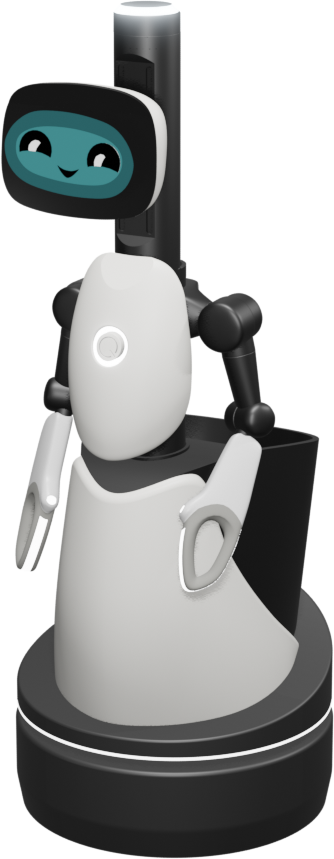
Quori v2
With recent $5-million NSF follow-on collaborative grants, Quori v2 is in development. The next generation will incorporate updated industrial design, Pixar-level animation expertise, enhanced software tools, and the Orbbec Gemini 335 as its flagship 3D vision system. For the first time, the platform will also be available for purchase internationally, opening the door for global collaboration in HRI.
Why the Orbbec Gemini 335?
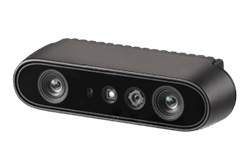
Included as a core component of Quori v2, the Orbbec Gemini 335 enables the robot to interact naturally with people by providing real-time, high-accuracy depth data for human tracking, gesture recognition, and social distance awareness. The Gemini 335 was selected as Quori’s flagship 3D vision solution for several critical reasons:
- Active Stereo Technology: The Gemini 335 integrates both active and passive stereo technologies, ensuring reliable depth data in fluctuating indoor lighting conditions.
- High Performance in a Small Package: Like the power solutions used in other OLogic projects, the Gemini 335 delivers high-density performance, processing complex depth maps without excessive bulk.
- Thermal and Power Efficiency: The camera is designed with an emphasis on thermals and efficiency, allowing Quori to maintain longer run times during research sessions.
- Wide Field of View: Its wide coverage allows Quori to capture comprehensive social scenes and track multiple interactants without blind spots.
- Person-Tracking: The Gemini series is ideal for 3D human pose estimation (“skeleton-tracking”), with software supporting the real-time tracking of 19 body joints for up to 5 people simultaneously.
OLogic’s Role: Making Social Expression Manufacturable
OLogic’s role was to transition Quori from a research prototype at the University of Pennsylvania to a scalable platform for the global HRI research community.
- Engineering Expressive Motion: OLogic helped solve the challenge of making “social expression manufacturable.” This included engineering a unique “chin-below-shoulders” mechanism, which OLogic’s Ibrahim Abdeally described as “the hardest and most expressive motion we engineered.”
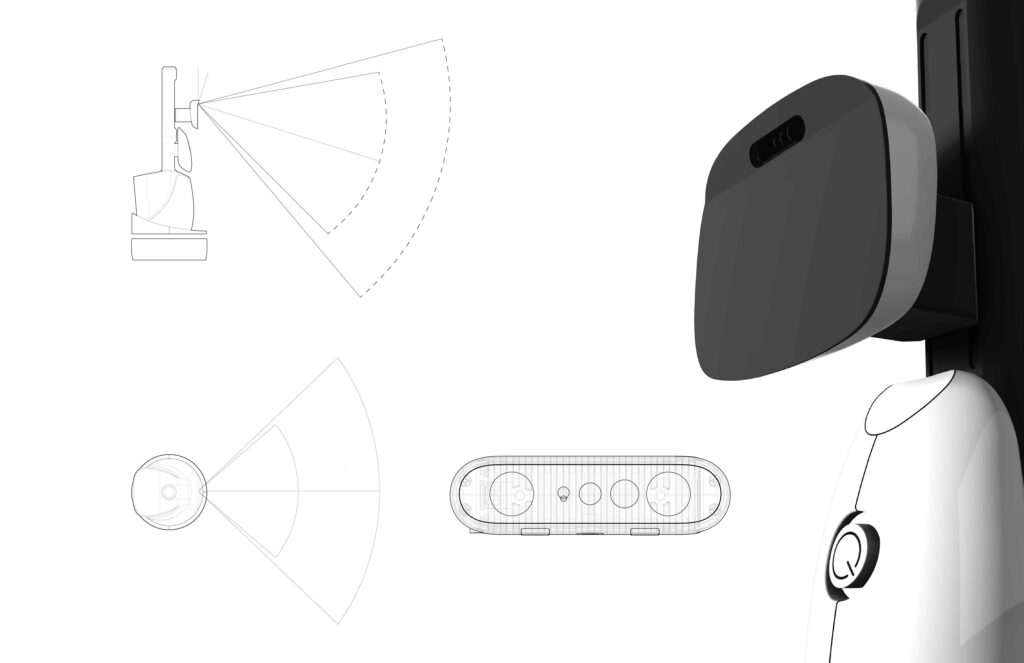
- Sensor Integration: The Orbbec Gemini 335 is strategically positioned on Quori’s head at a 17.5-degree downward angle, which was experimentally determined to maximize the effectiveness of the camera field of view for both object detection and person-tracking.
- Reliable Hardware Choices: Just as OLogic chose modular power systems for other robots to ensure they were reliable and robust, they selected Orbbec to provide a stable, high-performance perception layer.
Proof of Impact
The synergy between OLogic’s engineering and Orbbec’s perception has been proven in one of the largest real-world HRI deployments ever conducted:
- Scale of Interaction: Quori operated autonomously at the Philadelphia Museum of Art, interacting with more than 183,000 people.
- Reliability: The robot operated eight hours a day, seven days a week for six months, validating the platform’s durability and the quality of its sensing components.
About Semio Community
Semio Community is a nonprofit organization dedicated to advancing human-robot interaction through open-source robotics, collaborative research, and accessible technology. By fostering a global community of researchers and developers, Semio works to make robotics research more reproducible, scalable, and impactful.
Visit the Semio Community website here.
About Quori
Quori is an open-source social robot platform, designed to support research in human-robot interaction. Affordable, customizable, and built for real-world studies, Quori enables researchers worldwide to explore how robots can communicate, collaborate, and engage with people in meaningful ways. Quori v2 is being built in collaboration with Semio Community, Oregon State University, and the University of Pennsylvania.
Visit the Quori website here.
About OLogic
OLogic is a Silicon Valley engineering consultancy focused on turning complex hardware ideas into commercial-grade products that ship and scale. OLogic designs and delivers advanced electronics, robotics, and embedded systems, from early architecture and CAD through to manufacturing-ready designs, supporting clients from early-stage startups to global enterprises.
With 20+ years of experience and over 150 successful programs, OLogic combines deep technical expertise with disciplined execution to de-risk hardware development, operating with a strict 100% client IP ownership model to ensure clients retain full control of what they build.
Visit OLogic’s website here.